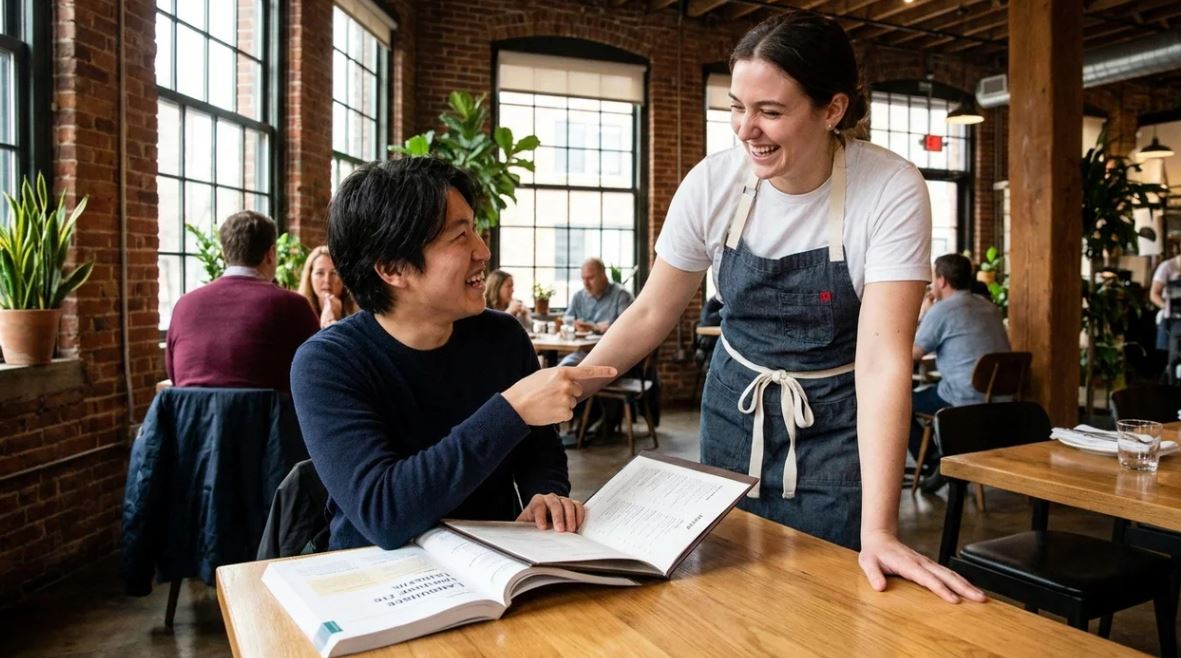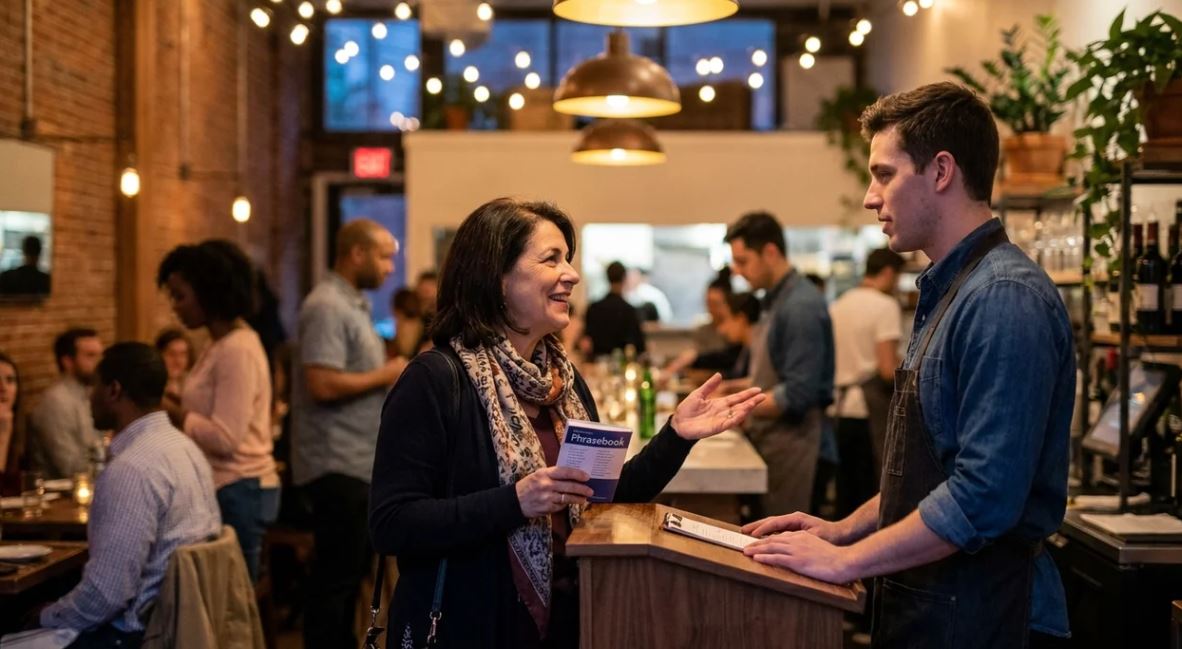

In this guide, you’ll learn how friendliness works in American restaurants, what servers usually mean when they ask personal-sounding questions, how to respond naturally, and why simple English often sounds the most natural.
This guide is adapted from a lesson in the ChatterFox Speaking Course, where learners practice real-world conversations and build confidence speaking English in everyday situations throughout the United States.
Let’s get started.
Why American Restaurant Service Feels Different
One of the biggest cultural differences many newcomers notice is the level of friendliness in American restaurants.
A server might approach your table and say:
“Hi, I’m Sarah. I’ll be taking care of you today.”
Or:
“How are you folks doing today?”
Or:
“How’s your day going?”
For many English learners, these questions can be confusing.
After all, they’re strangers.
Why are they asking about your day?
Do they really want to know?
The answer is usually:
Not really.
And that’s completely normal.
These questions are usually part of a friendly greeting.
They’re meant to help create a welcoming atmosphere rather than start a deep conversation.
Think of them as social rituals.
The goal is to make customers feel comfortable.

The Real Meaning Behind “How’s Your Day Going?”
Let’s look at one of the most common questions.
“How’s your day going?”
In most restaurant situations, the server is not expecting a detailed answer.
You do not need to explain:
❌ Your work schedule
❌ Your family situation
❌ Everything that happened today
Instead, a short response is perfect.
Natural Responses
✅ “Doing well, thanks.”
✅ “Pretty good. How about you?”
✅ “Good, thanks.”
✅ “Not bad.”
That’s it.
Simple.
Friendly.
Natural.
Why Americans Use Small Talk So Much
Small talk plays an important role in American culture.
You’ll hear it:
- In restaurants
- At grocery stores
- In elevators
- At work
- While waiting in line
Many Americans view small talk as a way to create a comfortable environment.
It’s not necessarily about exchanging important information.
It’s about being friendly.
When a server asks:
“How are you folks doing?”
They’re usually communicating:
???? Welcome.
???? I’m happy to help.
???? I hope you enjoy your meal.
Understanding this can make restaurant conversations feel much less confusing.
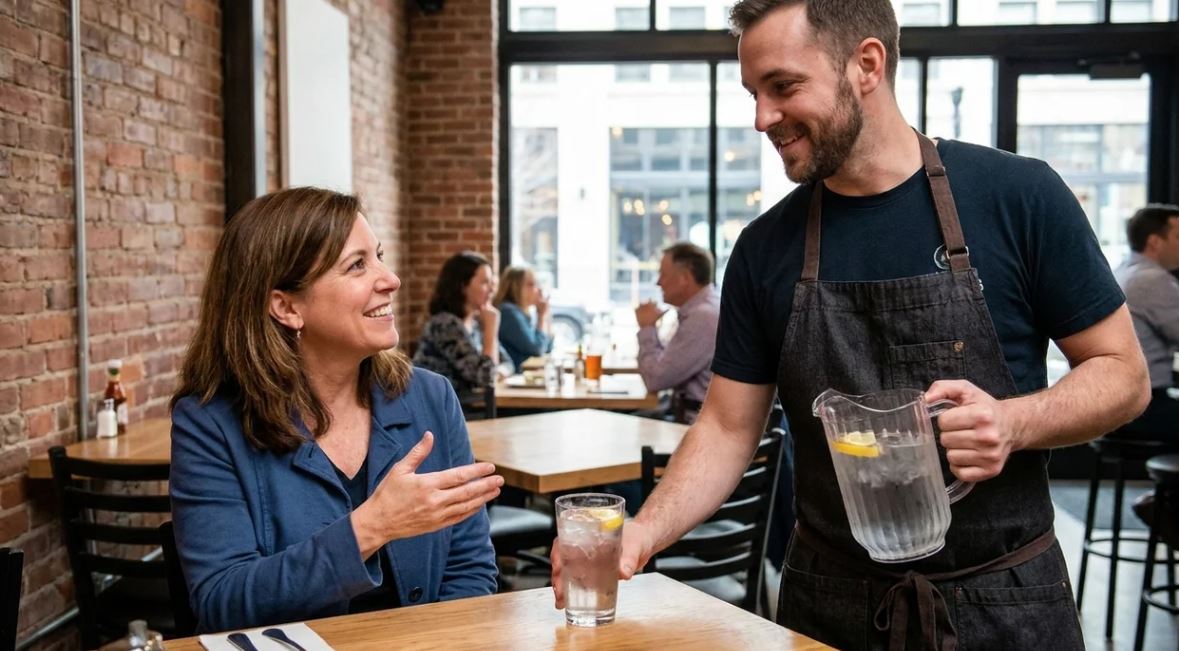
Friendly Doesn’t Mean Personal
One misunderstanding many newcomers have is assuming friendliness means friendship.
In American restaurants, that’s usually not the case.
A server may:
???? Smile
???? Ask how you’re doing
???? Make a joke
???? Check on your meal
???? Use your name
This doesn’t necessarily mean they want a personal relationship.
It’s simply part of the customer service culture.
Most Americans understand this automatically.
Once you realize that friendliness is part of the service experience, restaurant interactions become much easier to navigate.
Politeness Is Everywhere in American Restaurants
One thing you’ll notice very quickly is how often people use polite expressions.
Americans say:
Please
Thank you
Thanks
Appreciate it
All the time.
Even for very small interactions.
Why “Thank You” Matters So Much
Imagine this interaction:
Server:
“Here’s your water.”
You:
“Thank you.”
A few minutes later:
Server:
“Here’s the ketchup.”
You:
“Thanks.”
Later:
Server:
“Enjoy your meal.”
You:
“Thank you.”
This may seem repetitive.
But it’s completely normal.
In American culture, these small expressions help conversations feel respectful and friendly.
The Most Common Polite Phrases
Here are some phrases you’ll hear constantly:
Saying Thank You
✅ “Thanks.”
✅ “Thank you.”
✅ “Thanks so much.”
Showing Appreciation
✅ “Appreciate it.”
✅ “I appreciate that.”
Making Requests
✅ “Could I get some extra napkins, please?”
✅ “Can I have some ketchup, please?”
Notice how often Americans add “please” and “thank you.”
These small words have a big impact.
Why Simple English Sounds More Natural
Many English learners worry about creating perfect sentences.
But in restaurants, simpler is usually better.
Consider these examples.
Too Formal
❌ “Thank you very much for your assistance.”
More Natural
✅ “Thanks.”
Or:
✅ “Thank you.”
Too Formal
❌ “Everything is satisfactory.”
More Natural
✅ “Everything’s great.”
✅ “Looks good.”
✅ “Everything’s delicious.”
American restaurant conversations tend to be:
- Short
- Relaxed
- Friendly
- Informal
The simpler your response, the more natural you’ll sound.
Understanding Tipping Culture in the United States
One of the biggest surprises for visitors and immigrants is tipping.
In many countries, tipping is optional or uncommon.
In the United States, it’s generally expected at sit-down restaurants.
A tip is extra money left for the server after the meal.
Why Tipping Exists
In many states, restaurant servers receive a lower base wage because tips are considered part of their income.
As a result, tips play an important role in their earnings.
Because of this system, servers often work hard to provide attentive service.
They may:
- Refill drinks
- Check on your table
- Offer recommendations
- Make small talk
- Ask whether you need anything
This isn’t unusual.
It’s a normal part of American restaurant culture.
Why Servers Check on You So Often
Many English learners are surprised when servers return to the table several times.
You may hear:
“How’s everything?”
“Can I get you anything else?”
“Need a refill?”
“How are we doing over here?”
At first, this can feel excessive.
But in the United States, it’s generally viewed as good service.
The server wants to make sure you’re enjoying your meal.
Easy Responses You Can Use
The good news is that you don’t need complicated answers.
If Everything Is Fine
✅ “Everything’s great, thanks.”
✅ “We’re good.”
✅ “Everything’s delicious.”
If You Don’t Need Anything
✅ “No thanks.”
✅ “We’re all set.”
✅ “We’re good for now.”
These short responses sound perfectly natural.
Understanding “We’re All Set”
This is a phrase you’ll hear constantly.
“We’re all set.”
Meaning:
???? We don’t need anything else right now.
???? Everything is fine.
???? Thank you, but we’re okay.
It’s one of the most useful restaurant phrases you can learn.
A Typical American Restaurant Conversation
Let’s look at a realistic example.
Server:
“Hi folks, how are you doing today?”
You:
“Good, thanks. How are you?”
Server:
“Doing great.”
A little later…
Server:
“How’s everything?”
You:
“Everything’s great, thanks.”
Later…
Server:
“Can I get you anything else?”
You:
“No thanks, we’re all set.”
That’s it.
No complicated English.
No long conversations.
Just simple, friendly communication.
Common Mistakes English Learners Make
Mistake #1: Giving Answers That Are Too Long
Server:
“How’s your day going?”
❌ Five-minute explanation
✅ “Pretty good, thanks.”
Mistake #2: Worrying About Perfect Grammar
Many learners spend too much time creating perfect sentences.
Remember:
Restaurant conversations move quickly.
Simple communication is more important than perfect grammar.
Mistake #3: Thinking Friendliness Is Fake
Some newcomers assume servers are being insincere.
Usually that’s not the case.
Most servers are simply following the customer service style that’s common in American restaurants.
Mistake #4: Forgetting Basic Polite Expressions
Americans use “please” and “thank you” frequently.
Using these expressions helps conversations feel natural and respectful.
Quick Phrases to Memorize
Greetings
- Good, thanks.
- Doing well, thanks.
- Pretty good.
Responding to Service
- Thank you.
- Thanks.
- Appreciate it.
During the Meal
- Everything’s great.
- Everything’s delicious.
- Looks good.
When You Don’t Need Anything
- We’re all set.
- We’re good for now.
- No thanks.
Learning these phrases alone will make restaurant conversations much easier.
Final Thoughts
American restaurant culture can feel unusual when you’re new to it.
Servers may seem friendlier than you’re used to.
They may ask questions about your day.
They may check on you multiple times during the meal.
But once you understand the culture behind these interactions, everything starts to make sense.
Remember:
✨ Friendly questions are usually just greetings.
✨ Short answers are completely normal.
✨ Politeneness matters.
✨ Simple English often sounds the most natural.
✨ You don’t need long conversations to sound friendly.
The next time a server asks:
“How’s your day going?”
You don’t need to panic.
Just smile and say:
“Doing well, thanks.”
And you’ll sound perfectly natural.
That’s exactly how millions of Americans handle the conversation every day.